New
The Work Outlived the Job
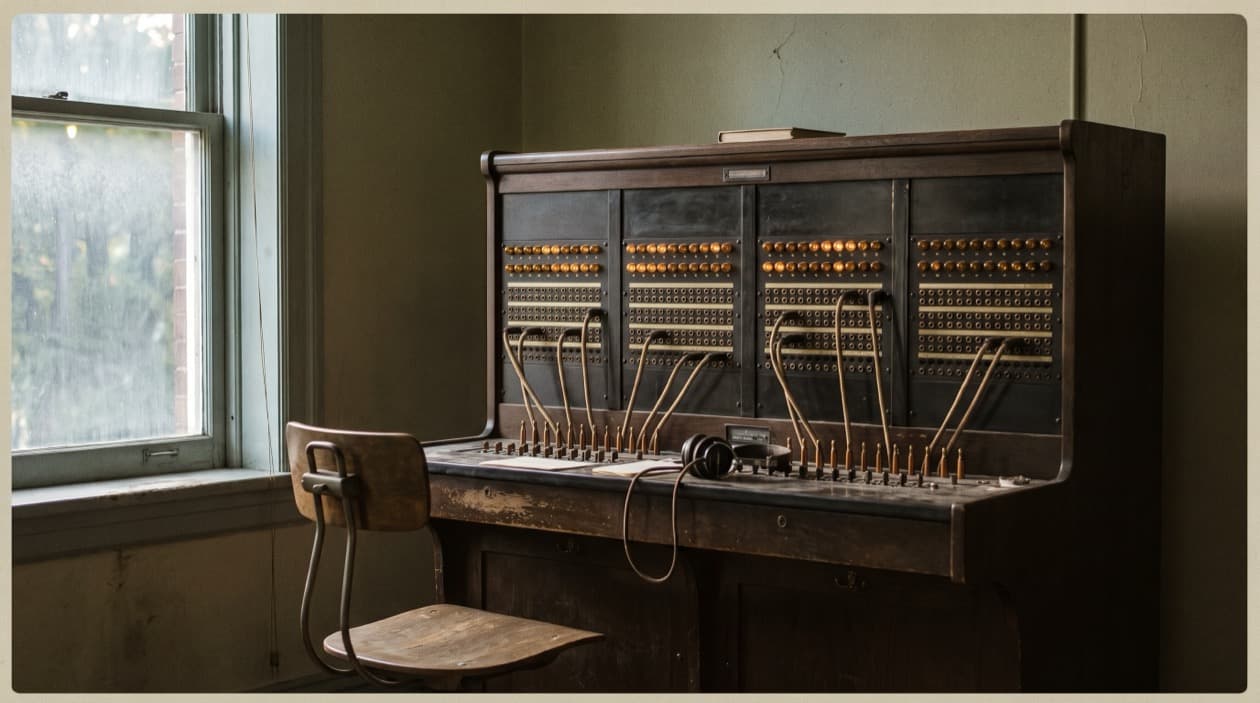
Mireille is a fictional composite and her last shift is invented; the event beneath the story is documented, and the people who kept its record are named at the end of this article.
In 1962 the telephone office in Matane still ran on cords, and Mireille, twenty-four that year, had worked its board long enough that the geography test from her hiring, the one that asked her to name the villages, the rangs, and the roads out to Sainte-Félicité, had long since turned from knowledge into reflex. She took her position the way she always had: headset on, cord pairs checked, keys tried, the directory and the pad of toll tickets squared in front of her. The only unusual thing about the shift was that everyone in the room knew it was the last one. The automatic exchange sat finished across town, tested and waiting, and starting tonight a dialed number would connect itself.
The first lamp of the morning belonged to a clerk at the building-supply counter who knew his number and said it cleanly. Answering plug into the jack, talking key forward, the number repeated back, front cord into the called line, ring. She watched the supervisory lamps just long enough to know the call had answered, and when the disconnect showed she took the cords down. The whole exchange cost perhaps thirty seconds. She would repeat some version of it more times that day than she could count, and she understood without bitterness that this, the clean number cleanly connected, was most of the job and the machine's entire case. Nobody had built the automatic for the other calls; they had built it for this one, and at this one it was very good.
Mid-morning a woman asked for the garage where the young Bérubé worked, not the one by the church, the one out toward Saint-Ulric. There were two garages on that side of town and only one had a Bérubé at the pumps. Mireille had the number up before the woman finished explaining. The machine, she thought, would have waited for digits. The woman had not brought digits; she had brought a person and a road, and somebody had to turn one into the other.
Before noon a merchant needed Rimouski. She took the particulars onto a toll ticket and passed the call into the long-distance path, where other operators would carry it onward and time it for the bill. That work was not ending tonight; the automatic was taking the town's calls, not the network's. Where the long-distance positions would sit afterward was not a question anyone asked out loud.
Once, while confirming that a connection had answered, half a sentence crossed her headset that was not hers to hear. She closed the key the moment the lamps allowed and carried the words nowhere, which was less restraint than procedure worn into character. Anyone at the board could technically listen to the town. The job was refusing to, hour after hour, so completely that no one thought to doubt it.
Early in the afternoon a lamp lit and the voice behind it gave no number at all. A woman, short of breath, saying a man's name and a stretch of the river road, asking for help without saying the word. Mireille asked one question, placed the house, rang the doctor's line, gave the location twice, and stayed on until she heard it repeated back. Then she took the next call. She did not think of what she had done as judgment. It was the job arriving in a different shape, the way it did a few times a season.
Between calls Jeanne, one position over, said, "The dial would have given her silence and then a wrong number." She said it as a fact, not a comfort. Mireille took it as one anyway, and let herself believe that as long as calls like that kept coming, somebody would have to stay in this room to take them. Jeanne pulled her cords down and said nothing more. She liked the room as much as anyone. She had simply never confused liking it with being owed it.
Paul, the technician who had spent the spring on the new exchange, came through late in the day and did not pretend otherwise. He thought the machine was honest work and said so: give it a complete number and it would connect faster than any pair of hands, give it anything else and it would do nothing at all. He respected what the operators did with the anything else. He just never claimed the machine's limits would keep the room open.
The supervisor said the rest plainly, near the end of the shift, without cruelty and without promises. Starting tonight, local calls would not enter this room; the exchange completed them itself. The long-distance work was being arranged from other positions. Responsibility for reaching help would rest with the caller and the directory. And no company staffs a room to wait for the rare call the machine cannot take, because those calls, real as they were, had never paid for the room; the ordinary ones had, and the ordinary ones were leaving. Nobody in that room was told she had not been good. Being good was not what the decision was about.
Her last connection was as clean as the first: a number, a ring, an answer, the cords down. Then the lamps stopped arriving. The board was not broken; it was simply no longer in the path. Somewhere in town a subscriber lifted a receiver, dialed, and a telephone rang with no one in between; the machine's first night went exactly as its makers intended.
Some evenings later her own telephone rang, dialed direct. A voice she half knew: the number she had for the notary was not answering, whom should she call at this hour? Mireille gave another number from memory, the right one, in about ten seconds. No one paid for those seconds and no schedule carried her name. The next person with the same question would reach whoever they happened to know, or no one. What Mireille knew had not stopped being useful. It had stopped having a desk. The town's calls went through better than ever, and the questions that were not calls went wherever they could.
What actually happened here
The story is fiction: Mireille, Jeanne, Paul, the supervisor, the callers, the dialogue, the emergency, and the shift itself are invented. The testimony behind it is real, gathered by Radio-Canada in 2021. Romain Pelletier, in issue 112 of Au pays de Matane, the journal of the Société d'histoire et de généalogie de Matane, recorded that the town's operators lost their jobs "du jour au lendemain," from one day to the next, when automatic dialing arrived in 1962, and that the switchboard had been skilled work, one of the rare routes to paid independence for the region's young women. Burniss Perry, who began at the board at seventeen, described the writing and geography tests for applicants, and operators who heard distress in a voice and set help moving on their own initiative. Rollande Imbeault Ruston described operators who could technically listen to anything and understood that all of it had to stay secret. The record beyond that is thin and this article stays inside it: no exact cutover date, no staffing counts, no severance terms. The exchange took the high-volume path and worked; local knowledge, discretion, and emergency judgment did not become useless, they stopped supporting the same local occupation. Some work was automated, some likely moved to other operators and institutions, some responsibility moved to the callers, and some local context may simply have stopped being available.
Say it plainly first: you are not the operator. The tools arriving in bookkeeping do not remove the bookkeeper; they multiply her. Telephony's switch was deterministic and total, while extraction tools are probabilistic and partial, and their failures need owners. The two situations share one line of arithmetic: the number of production seats a trade supports is the total work that must be humanly owned divided by the work one person can own. When each remaining bookkeeper can handle five times the routine volume, the same client base supports fewer production seats, even though every remaining seat is doing important human work. Matane proves the harshest form of that accounting: the machine worked, the women were excellent, the residual needs were real, and the local seats still ended. The count can be defended by growing the work, and nothing guarantees that growth lands in your region, your cabinet, or your seat.
Watch where the work goes, not whether it stays; five destinations, to investigate in your own files, never to predict. Some work is removed: nobody retypes the clean statement line. Some is compressed: one bookkeeper clears the exception queue behind bulk extraction, and you may already be living that under the name productivity. Some concentrates: hard cases pool with fewer specialists serving more files. Some transfers: to the client, the software, the CPA, or a government portal. And some ends up unowned: the flagged row nobody investigates because the fee still assumes routine hours subsidize investigation.
Exceptions, client context, accountability: those attach a person to the work that remains. Mireille had all three at local scale, and the seat still ended: ownership was reallocated above her head. Ownership defends a seat only when its holder also holds the client relationship or the engagement, and even then it defends a seat, singular. Owning the exceptions keeps you in the room; it does not keep the room the same size.
Matane settles nothing about bookkeeping's outcome. It retires a bad question, which tasks the machines will take, and installs a better one: when each of us can clear several times the routine volume, how many paid seats does the remaining humanly owned work support, where do they sit, and who decides.
The exercise fits on a page: take two recent working weeks, real ones, and note, for each piece of work, the routine part, what made you stop and decide, and who would see the flag if a tool did the routine. Then three questions. At that speed, how many seats does your current book of clients justify? What would have to grow, in clients, scope, or paid services, for the count to hold? Who holds the relationships and engagements that decide where the surviving seats sit?
No response promises safety. The three strongest: price exception ownership, investigation, and accountability separately from throughput, which is what the lever devalues; hold the client relationship, because the reallocation decision follows it; fill freed capacity on purpose, with new clients and new scope. Then accept that a well-run cabinet can keep every client, adopt every tool correctly, and still end with fewer production seats. Seeing that early buys you a say in which seats they are.
The machine kept its promise, the women were as good as the record says, and the needs that outlived the board went wherever they could. The work survived. The arithmetic decided who stayed.